WhatsApp is often one of the easiest ways for customers to contact a taxi company and request a ride. For smaller operators, manually managing these conversations may work while booking volume, fleet size, and service complexity remain limited.
The difficulty begins when staff must collect trip details, confirm service areas, calculate fares, check driver availability, arrange payments, and re-enter every request into a separate system. As demand grows, manual handling can cause slower responses, missing information, assignment delays, and inconsistent customer service.
Moving beyond manual WhatsApp taxi booking does not mean abandoning WhatsApp. It means connecting WhatsApp taxi booking software with a structured taxi booking system, centralised dispatch, and a branded passenger app so every request enters one controlled workflow.
Customers can continue using WhatsApp when they prefer conversational booking. Regular passengers can use the branded app for faster self-service booking, payments, ride tracking, and trip history. Your operations team manages rides from both channels through the same booking and dispatch platform.
This guide explains when manual WhatsApp booking stops scaling, how a connected booking workflow solves the problem, and how WhatsApp and a white-label taxi app can operate together.
Let’s start with the pros and cons of using WhatsApp for your taxi business.
Pros and cons of using WhatsApp for your taxi business
WhatsApp works well as a customer-facing communication and booking channel. Customers already understand how to use it, and operators can answer questions, confirm ride requirements, and share updates without asking passengers to install another application.
The limitation is not WhatsApp itself. The limitation appears when every conversation must be handled manually and remains disconnected from pricing, payments, driver availability, dispatch, tracking, and reporting.
Let’s explore the pros and cons of using WhatsApp for your taxi business.
Where WhatsApp Works Well for Taxi Bookings
| Benefit | Description |
|---|---|
| Low customer adoption barrier | Customers can request a taxi without downloading or learning how to use another application. |
| Direct customer communication | Operators can answer questions, confirm booking details, and send trip updates through a familiar channel. |
Now let’s explore the cons of using WhatsApp.
When Manual WhatsApp Booking Stops Scaling
The goal is not to eliminate WhatsApp. It is to connect the channel with taxi booking software and taxi dispatch software so customer conversations become structured, dispatch-ready rides without repeated manual entry.
With the right workflow, WhatsApp can remain available for customers while the booking system manages fare rules, driver assignment, payments, tracking, notifications, and reporting in the background.
Keep WhatsApp. Remove the Manual Work.
See how Yelowsoft connects WhatsApp, branded apps, and dispatch in one booking workflow.
See the Connected Booking Workflow
Benefits of switching to a white-label taxi app
A connected booking workflow gives customers more choice without creating separate operational processes. Passengers can request rides through WhatsApp or use your white-label taxi app, while both booking channels feed the same dispatch system.
Here is what operators gain when WhatsApp, branded applications, and dispatch software work together.
| Benefits | Description |
|---|---|
| Multichannel booking | Accept bookings through WhatsApp, your passenger app, web booking, and phone while managing every ride from one dashboard. |
| Efficient fleet management | Automates the booking process and makes it easier for you to dispatch drivers. It also ensures fair ride distribution with just a few tabs. |
| Payment flexibility | You can easily integrate your choice of payment gateway to offer an easy checkout option to your passengers. They can pay via card, wallet, or local systems at their fingertips. |
| Customer satisfaction | Offers features like real-time tracking, fare estimation, cashless payments, and referral discounts—all within one user-friendly app. |
| Business analytics | The app comes with advanced reporting and analytics tools that empower you to track driver performance, ride stats, revenue, and customer satisfaction. This will help you make informed and data-driven decisions. |
| Scalability | The White label taxi app is designed to grow with your business. Whether you are expanding your fleet, entering new areas, or adding services like ride-sharing or delivery – the app can scale smoothly as you grow. |

What to Consider When Adding a Branded Taxi App
Adding a branded taxi app introduces setup, onboarding, adoption, and provider requirements. These considerations are easier to manage when the app is introduced alongside WhatsApp rather than forcing every customer to change their booking behaviour immediately.
Initial investment
Taxi software requires an upfront investment, whether you are purchasing it whole or using it on a subscription model.
Evaluate the expected operational savings, booking growth, customer adoption, and subscription cost before selecting a platform.
Training time
Dispatchers and drivers need practical onboarding when a connected booking and dispatch system is introduced. Customers, however, can adopt the branded passenger app gradually while WhatsApp remains available as a familiar booking channel.
Technical dependencies
Any booking platform creates a dependency on its provider’s hosting, maintenance, security, support, and integration capabilities. Review uptime, data ownership, software updates, migration support, and integration options before choosing a provider.
A Step-by-Step Guide to Moving Beyond Manual WhatsApp Booking
Moving beyond manual WhatsApp booking should be a gradual operational transition, not an abrupt channel replacement. The objective is to connect WhatsApp, your branded applications, driver operations, and dispatch within one controlled system.
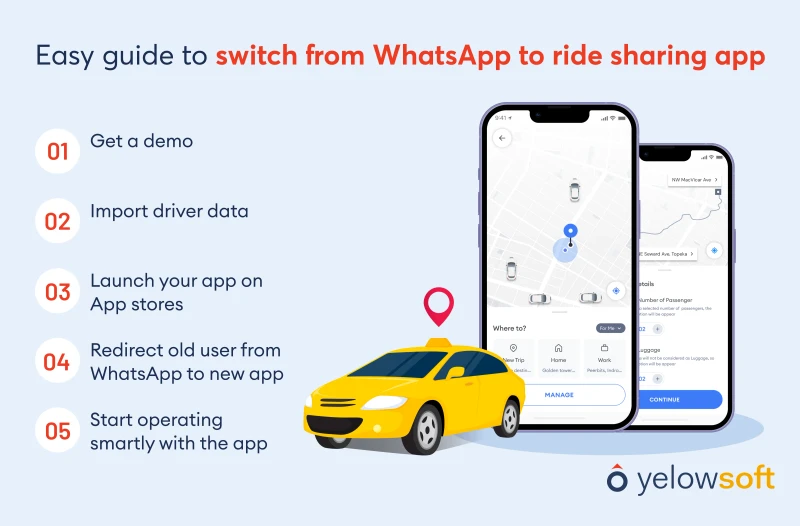
Personalized demo
We organize a personalized demo where you can share business and software requirements. You will have a complete walkthrough of the app.
Connect WhatsApp to Booking and Dispatch
Configure WhatsApp as an integrated booking channel. Customer messages should be converted into structured booking details and sent directly into the dispatch system without requiring staff to copy and re-enter the ride manually.
Driver integration
Our experts then help you import your current drivers into the new system and send them automatic invites to start using the app.
App store release
We help you launch your customer and driver app in the App Store and Google Play. This makes it easy for your drivers and passengers to access the app easily.
Suggested: Importance of App Store optimization for your business
Introduce the Branded App to Existing Customers
Keep WhatsApp available while introducing the passenger app as an additional booking option. Explain that the app offers faster self-service booking, live tracking, digital payments, saved locations, and ride history, while WhatsApp remains available for conversational requests.
Start operating
Launch the connected workflow in phases. Monitor booking sources, response times, booking completion, driver assignment, and customer adoption before reducing any remaining manual processes.
Suggested: A complete guide to white label ride share app development
How to choose the right white label ride sharing app for your business
When selecting a white-label taxi app and dispatch platform, confirm that WhatsApp can operate as a connected booking channel rather than as a separate inbox that still requires manual processing.
| Capability | Manual WhatsApp Booking | Connected WhatsApp, App and Dispatch Workflow |
|---|---|---|
| WhatsApp booking access | Available | Available and automated |
| Structured trip-data collection | Staff dependent | Captured consistently |
| Booking creation in dispatch | Manual re-entry | Automatic |
| Branded passenger app | Not available | Available |
| Automated driver assignment | Not available | Available |
| Fare and payment management | Usually handled separately | Connected to booking rules and integrations |
| Live tracking | Shared manually | Available through app or tracking link |
| Fleet management | Not available | Centralised |
| Booking analytics | Limited | Available by channel and trip source |
| Scalability | Dependent on staff capacity | Supports higher booking volume |
| Customer channel choice | WhatsApp only | WhatsApp, app, web and phone |
The right decision is not WhatsApp or a white-label taxi app. The stronger model allows WhatsApp, the passenger app, web booking, and phone reservations to feed the same booking, dispatch, payment, tracking, and reporting workflow.
Why choose Yelowsoft’s white label taxi app?
When it comes to choosing the right app provider, Yelowsoft offers features and benefits tailored to your taxi businesses despite of the size, number of fleets or drivers.
Yelowsoft connects automated WhatsApp booking, branded passenger and driver apps, taxi booking software, and central dispatch within one configurable platform.
With Yelowsoft, you can:
-
Can scale your business indefinitely: Yelowsoft processes millions of trips every day with no cap on how many rides your business can handle.
-
Get regular updates: Stay ahead of the competition with free monthly updates that introduce new features.
-
Get 24/7 support: Our customer support team is always available to address your issues or query and resolve them quickly.
-
Can launch your branded app on App stores: We’ll help develop and launch your branded app launch on Apple Store and Google Play with ease. This makes it easier for your customers to find and use your service.
Conclusion
WhatsApp remains a valuable booking and communication channel for taxi businesses. The real limitation appears when every customer message must be manually interpreted, confirmed, transferred into dispatch, and coordinated with drivers.
A taxi business should move beyond manual WhatsApp booking when message volume slows response times, booking details become inconsistent, driver assignment requires repeated coordination, or customers expect faster payments, tracking, and self-service options.
A connected workflow allows customers to continue booking through WhatsApp while other passengers use your branded app. Both channels can feed the same taxi booking and dispatch system, giving your team central control without forcing every customer into one booking method.
Connect Every Booking Channel to One Dispatch Workflow
See how Yelowsoft connects WhatsApp, branded apps, and dispatch in one booking workflow.
Book a Demo
Frequently Asked Questions
Manual WhatsApp booking stops scaling when staff struggle to respond quickly, capture complete trip details, assign drivers, confirm payments, or transfer every request into dispatch without errors.
Yes. WhatsApp can connect with taxi dispatch software so booking details are collected, validated, and converted into dispatch-ready rides without manual re-entry.
A passenger app gives regular customers self-service booking, fare visibility, payments, tracking, saved details, and ride history. WhatsApp can remain available for customers who prefer conversational booking.
Yes. WhatsApp and a white-label taxi app can operate as separate customer booking channels while sending confirmed rides into the same booking and dispatch system.
Keep WhatsApp active, introduce the branded app gradually, explain its benefits, and allow customers to choose their preferred booking channel instead of forcing an immediate switch.
WhatsApp bookings should enter the same central dashboard as app, web, and phone bookings, where operators can assign drivers, track rides, manage payments, and report performance.